Leads generated by my AI systems
485 new leads a day by October, 4.3x the July pace. Every one captured, followed up and traced to its source by AI.
For HVAC companies · free 30-minute strategy call
I'm Jon Dykstra. I run my own businesses on AI: millions of visitors, tens of thousands of leads, and 1,878 ad campaigns launched by AI, every one judged every morning on what it actually returned.
An HVAC company's year is decided by a few kinds of days: the first heat wave, the first cold snap, and every kitchen-table conversation about a new system. This machine is built to win those days, and to keep the quiet weeks in between full.
Leads = opted-in email subscribers and home-equity lender leads across businesses Jon owns, Jan 1–Oct 14 2026. Not HVAC client results.

Free, 30 minutes, phone or Google Meet. No pitch deck.

The HVAC year
You already know the pattern. A hot week arrives and the phones light up faster than anyone can answer them. A cold snap does the same thing to furnaces. Then spring and fall go quiet, the techs need hours, and everyone wishes they'd planned tune-up campaigns a month earlier.
Most HVAC marketing doesn't move with any of that. The ad budget is set once and left alone. The website says the same thing in July and January. Maintenance customers get a reminder whenever someone in the office remembers. And on the busiest days, when every lead is worth the most, the calls that don't get answered simply go to whoever calls back first.
Here's where the money slips away:
A system that watches every lead, every quote and every campaign every day, and remembers what happened last season, fixes all six.
The proof
None of this is theory. In my own businesses, AI launched 1,878 ad campaigns between June and October, and judged every one of them every morning. It managed US$136K of Facebook ad spend in 2026, growing from US$460 a week to US$19.8K a week as the results justified it. It bought more than 3M ad clicks for my two largest sites and brought in about 485 new leads a day in October.
Jon's own portfolio. Figures are from businesses Jon Dykstra owns and operates on AI. They are not client results. Data to Oct 11 2026 unless noted. Leads = opted-in email subscribers and home-equity lender leads across businesses Jon owns, Jan 1–Oct 14 2026. Not HVAC client results.
Leads generated by my AI systems
485 new leads a day by October, 4.3x the July pace. Every one captured, followed up and traced to its source by AI.
An HVAC lead is a family with no air conditioning in July. My leads are email sign-ups and lender leads. The machine underneath is the same.
It captures every lead, responds in minutes, qualifies it, follows up until it books, traces every job to its source and moves money to what works every morning. The difference in HVAC is that the stakes swing with the weather and the tickets get big. That makes speed and follow-up worth more in your business than in most.
The AI operating system for an HVAC company
Your phones, Google Ads and Local Services Ads, Facebook, website, Google Business Profile, field-service software and maintenance-agreement list all feed one core: the rules that decide what to do, and a memory of what booked jobs, season by season.
You set the budget, the limits and the words AI may use with homeowners. AI answers, qualifies, follows up, books, measures and tunes inside them, every day.
When the weather turns
Peak days are when every lead is worth the most and when your office is least able to answer. That's the moment this workflow was built for.
Every call that rings out gets a text within about a minute: "We got your call. What's happening with your system?" AI reads the reply and sorts it by rules you write. No cooling with an infant, an elderly parent or a medical need at home is flagged urgent and sent to a person right away. A system that's running but not keeping up gets offered the next open slot. A routine tune-up request is booked into a slower day. Every call is logged with its source, so you can see the next morning exactly how many people you'd have lost.
The same thing works in reverse in January. A no-heat call at 10 pm gets a reply, a triage and, by your rules, either your on-call tech or a first-thing appointment.
Every lead, labelled and qualified
Every source gets its own tracking number and tagged links, so each call, form and chat arrives with where it came from, what system the homeowner has and where they live. Then AI qualifies it with the questions your best CSR would ask, in plain language:
The answers decide what happens next. A repair goes to the schedule. A replacement-minded homeowner goes to your comfort advisor's calendar. A "just thinking about it" goes into a nurture sequence that keeps you top of mind until they're ready. You choose the questions and the criteria.
Replacement and installation
A new system is one of the bigger purchases a homeowner makes, and most of them start researching before they ever call. They want to know whether to repair or replace, roughly what it costs, what size they need and whether they can spread the payments out. The company that helps them answer those questions early is usually the one that gets invited in.
So the system works the replacement funnel on purpose:
A homeowner clicks a "repair or replace?" ad on a Tuesday evening and answers four questions: the system is 16 years old, this is the third repair call in two years, they own the home, and they'd like to hear about monthly payments. AI books the comfort advisor for Thursday at 5 pm and sends him the brief. By the time he rings the doorbell he knows the age, the history and the question that matters most to them.
Quotes that close
Homeowners rarely sign a system quote on the spot. They compare, they talk it over, they wait for a paycheque or a cooler week. The company that follows up well, politely and with something useful to say, wins a share of those quotes that would otherwise go to someone else.
AI follows up on every open estimate on a cadence you set. A typical starting point is day 3, day 7 and day 14. Each message is written for that quote: the options presented, the financing available, answers to the questions they asked during the visit. Simple questions get answered. Anything about price, scope or a competing quote goes to your comfort advisor, with the history attached. When a quote is won or lost, the reason is recorded so the follow-ups improve.
Ads that follow the weather
The best HVAC advertising is timed. AC repair ads should be loudest when it's hot. Furnace ads should be loudest when it's cold. Tune-up and replacement campaigns belong in the shoulder seasons, when your techs have open hours.
The system watches the forecast and your schedule. Ahead of a heat wave it shifts budget toward cooling repair in the areas that will feel it first, and pauses the campaigns that don't make sense that week. When the schedule is full, it can pull back on emergency ads you couldn't serve anyway. When the weather goes mild and the board empties, it moves money into tune-up and replacement campaigns. All of it happens inside the daily and monthly caps you set, and it never raises your total without your approval.
Every morning every campaign is judged on booked jobs, the same way I judge 1,878 campaigns in my own businesses. Losers are paused by rule. Winners get more budget.
The recurring revenue
Maintenance agreements are the steadiest money in an HVAC company, and they're easy to lose through neglect. A customer who doesn't get reminded doesn't book. A customer who doesn't get a tune-up doesn't feel the value. A customer who doesn't feel the value doesn't renew.
AI runs the agreement calendar from your software:
Working with your dispatch board
Your field-service software is the source of truth for who's where. The system works alongside it, wherever the tool's API and your plan allow.
Connections to ServiceTitan, Housecall Pro and other field-service tools depend on each tool's API and your plan, and are confirmed during the audit.
The morning report
Overnight, AI collects yesterday's ad spend, calls, bookings, estimates, installs and agreement renewals, and checks the totals against their sources. At 7 am you get a short report:
If the numbers don't reconcile, the report stops and says why instead of guessing. I run my own businesses on that rule. Accounting connections are read-only, so AI reports on the books and never moves money.
Why it gets better every season
Most HVAC companies relearn the same lessons every year. Which offers worked in the first heat wave. How fast the tune-up slots filled. Which areas called the most. By the next season, nobody remembers the details.
It runs an engineered improvement loop every day:
A real example from my own businesses shows why the rules themselves need testing. My early ad rules judged new campaigns too soon and turned out to be killing future winners. The system tested the rule against results, learned to wait for more data, and profitable campaigns that would have been switched off stayed alive. In an HVAC company, the same discipline applies to when you judge a heat-wave campaign or when you send a quote follow-up.
What it looks like
The owner's part is in gold. Everything else runs on its own.
Forecast: 96°F by mid-afternoon. AI shifts budget toward AC repair ads in the hottest zip codes, inside the daily cap, and pauses the furnace tune-up campaign for the week.
The owner gets the report: 41 calls yesterday, 6 missed and all 6 texted back within a minute, 22 jobs booked, 3 replacement estimates out, cost per booked job by campaign.
YouRoutine tune-up requests that came in overnight are moved to next week's open slots, keeping today's board free for no-cool calls.
Phones spike. Every overflow call gets a text. Routine requests self-book into open slots, and "no cool with an infant at home" is flagged urgent for the dispatcher.
The board is full through tomorrow. AI pulls back on emergency ads in the farthest zip codes so the company isn't paying for calls it can't run.
Two replacement estimates from last week get their day-7 follow-up with financing options. One homeowner asks about warranty terms; AI routes it to the comfort advisor.
A tech notes a 17-year-old system on a repair. The customer is added to the replacement-options sequence the owner approved last month.
Plan customers whose fall tune-up is due get a reminder with a self-booking link for late September.
AI proposes a test: an "AC check before the next heat wave" offer for past customers without a plan. The owner approves it from the phone.
YouEvery call, quote and install is reviewed. Follow-up timing, offers and ad rules are updated from what actually booked, and the heat wave's pattern is saved for next year.
On the busiest day of the season, the owner spent a few minutes reading one report and approving one test.
Your command center
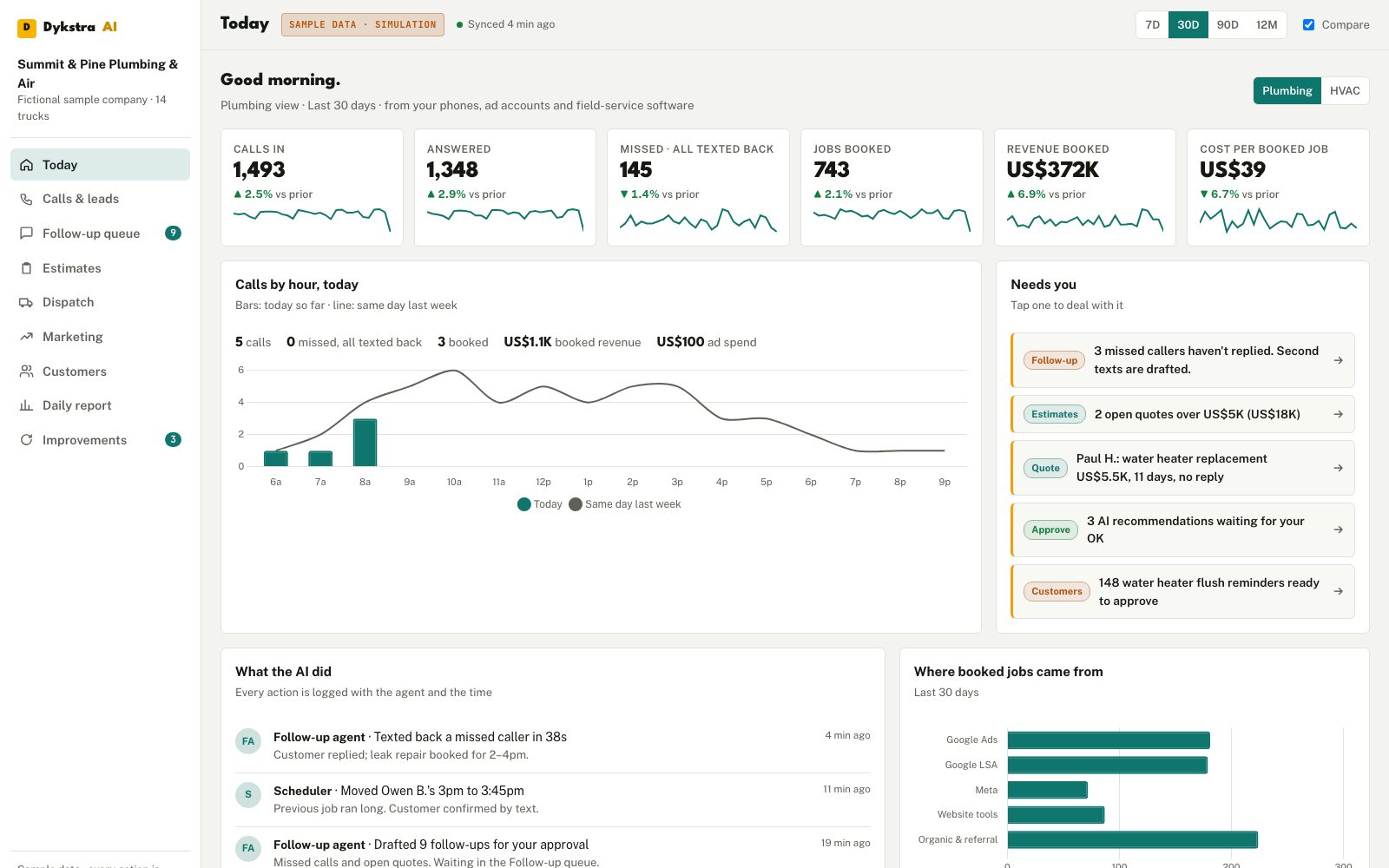
This is the owner's chair. Peak-day call overflow, with missed calls already texted back. Replacement estimates in the pipeline and the ones that need you. Maintenance plans due for renewal. The dispatch board and jobs booked. Cost per booked job and cost per install by ad, with AI working the queue, a 7 am report and an assistant you can ask "how many agreements lapsed last month?"
Click around. It's a fictional company with sample data, and the workflow is the real one.
Interactive demo with fictional sample data. Every action is simulated.
Sample data · click to explore
Optional add-on · custom AI tools
Replacement buyers research before they call. A tool on your website answers the questions they're already asking and ends with a free in-home estimate button. It's optional, and most clients start with follow-up, ads and tracking. We can build whatever fits your company. A few ideas:
Leads from a tool flow into the same qualification, comfort-advisor hand-off and follow-up as every other lead.
Who you're talking to

In 2025 I handed my businesses to AI one job at a time: content, ads, bidding, social, email, lead follow-up and reporting. Each job went to AI only if AI could do it better, faster and cheaper than a person. Plenty broke along the way. I fixed it with my own money on the line and kept what worked.
Today that system runs at real scale: 46,800+ leads, 27.3M pageviews and 1,878 AI-launched ad campaigns this year, every campaign judged every morning on what it actually returned. In my own words from the report, "I get roughly 25x done in a quarter of the time." That's my estimate, not a measurement, and it's the reason I now build this for other owners.
I'm not an HVAC contractor, and I won't tell you how to size a system or run an install crew. What I bring is the part most HVAC companies are short on: the daily discipline of answering every lead, following up every quote, tying every dollar to a booked job and remembering what worked last season. I trained as a lawyer and earned an MBA, so I judge every system like an owner: does it make money, does it save time, and can I trust the numbers?
A client build for a plumbing company is underway now, and I'm currently accepting a few more clients.
Jon's own portfolio. Figures are from businesses Jon Dykstra owns and operates on AI. They are not client results. Data to Oct 11 2026 unless noted. Leads = opted-in email subscribers and home-equity lender leads across businesses Jon owns, Jan 1–Oct 14 2026. Not HVAC client results.
You stay in charge
You set the goals, budgets and limits. AI does the work inside them. Anything that spends money, contacts customers or changes the business can require your approval, and everything is logged.
Everything is built on your own accounts. Your ad accounts, phone numbers, website, software and data stay yours, along with every lesson the system learns.
How it works
Everything is built on your own accounts. You own all of it. We run it for you, or train your office to run it.
We map your marketing and operations and rank every job AI could take over by the money and hours it frees up. We'll also look at where you are in the season, so the first things built are the ones that matter next.
The AI systems, tracking and dashboards go in on your own accounts.
Want your team to run it? We train them on every system until they're confident without us.
Rather not? We run it for a monthly fee. AI does the work; we watch the numbers and tune the system.
AI brings new tests built on your results. You approve them and AI carries them out.
Good timing. The shoulder season is the easiest time to build, because the system is ready and has some data before the next peak arrives.
Because the hard part was never the equipment. It's answering every lead fast, qualifying it well, following up until it books, judging every ad on real results every morning and remembering what worked. I do that across millions of visitors and tens of thousands of leads a year in businesses I own. You bring the trade. I bring the machine.
Questions
No, and I'll never pretend they are. The 46,800+ leads and the charts on this page come from businesses I own and run on AI. They're email sign-ups and home-equity lender leads, not service calls. A client build for a plumbing company is underway now. What I'm offering is the same machine, built for your company, on your accounts.
That's where it earns its keep. Every missed call gets a text within about a minute, routine work self-books into slots you've opened, and urgent no-cool or no-heat calls are flagged for a person, all by rules you set.
We connect to the field-service software you already use wherever its API and your plan allow it, so calls, bookings, agreements and jobs flow into the reporting. You can start read-only. If a connection isn't possible, I'll tell you on the call and we'll work around it.
No. AI qualifies, books the in-home visit and follows up on the estimate your comfort advisor wrote. System recommendations, pricing and the sale stay with your people.
No. You set daily and monthly caps. AI moves budget between campaigns inside those caps, including weather-driven shifts, and pauses losers by rule. It never raises the total without your approval.
Yes. Seasonal reminders, self-booking and renewal follow-ups are some of the fastest wins, because they fill slow weeks with customers you already have.
Any time. The shoulder seasons are the easiest, because the system is in place and learning before the phones get busy. If you're mid-season, we start with missed-call follow-up and tracking, which help right away.
It depends on what AI should take over first and whether we run it or teach your team. You'll get a straight answer and a clear scope on the free call. If you'd like to see how I think first, read the free report. Read the free report first →
Free strategy call
Phone or Google Meet, your choice. Times show in your time zone. Only a small number of businesses are taken on at a time. Not ready? Read the free report or send a message.