For plumbing companies · free 30-minute strategy call

I built an AI lead machine that brought in 46,800+ leads this year. Now I build it for plumbing companies.

I'm Jon Dykstra. I run my own businesses on AI: millions of visitors, tens of thousands of leads, and 1,878 ad campaigns launched by AI, every one judged every single morning. Every lead gets captured, followed up and traced to its source.

Plumbing companies lose jobs in the same places my businesses used to: calls nobody answers, quotes nobody chases, and ads judged on clicks instead of booked work. That's exactly what this machine fixes.

46,800+leads generated in 2026
485/daynew leads by October
27.3Mpageviews in 2026

Leads = opted-in email subscribers and home-equity lender leads across businesses Jon owns, Jan 1–Oct 14 2026. Not plumbing client results.

Free, 30 minutes, phone or Google Meet. No pitch deck.

Jon Dykstra, founder of Dykstra AI
Jon Dykstra, LLB, MBA. Runs his own businesses on AI, every day.

Where plumbing companies lose jobs

You don't have a lead problem. You have a leak problem.

If you've been in business a while, the phone already rings. Your trucks are known in town, your reviews are decent and you're spending real money on Google and maybe Facebook. The money that goes missing goes missing after the phone rings, somewhere between the first call and the booked job.

Here's where I'd look first in almost any established plumbing company:

  • The 9 pm burst pipe goes to voicemailThe homeowner calls the next plumber on the list. You never knew they called.
  • Water-heater quotes go coldA replacement quote sits in someone's inbox. Nobody follows up, so a competitor books it.
  • Ads get judged on clicksGoogle and Facebook report cheap clicks. Nobody can tell you which ad booked which job.
  • "How did you hear about us?" is the tracking systemSo the budget follows gut feel instead of booked revenue.
  • Marketing happens at 10 pmYou run crews all day. The website, the reviews and the posts wait until you're exhausted.
  • Past customers drift awayThe people who should be booking a drain cleaning or a water-heater flush never hear from you again.

None of those are marketing problems in the usual sense. They're follow-through problems. Follow-through is the thing people are worst at when they're busy, and it's the thing AI does best.

The proof

Tens of thousands of leads. Millions of visitors. Every day, run by AI.

This isn't a course or a slide deck. It's the machine I run on my own businesses right now. In a single week in October, AI launched 299 ad campaigns, published 145 pages and brought in roughly 485 new leads a day, every one followed up and traced to its source.

46,800+leads in 2026Jan 1–Oct 14 2026
27.3MpageviewsFeb 23–Oct 11 2026
1,878ad campaigns launched by AIJun 22–Oct 11 2026
3M+Facebook ad clicks bought by AI2026, two largest sites

Jon's own portfolio. Figures are from businesses Jon Dykstra owns and operates on AI. They are not client results. Data to Oct 11 2026 unless noted. Leads = opted-in email subscribers and home-equity lender leads across businesses Jon owns, Jan 1–Oct 14 2026. Not plumbing client results.

Leads generated by my AI systems

46,800+
leads in 2026 across the businesses I own and run on AI

485 new leads a day by October, 4.3x the July pace. Every one captured, followed up and traced to its source by AI.

Opted-in email subscribers and home-equity lender leads · Jan 1–Oct 14 2026

Leads generated in 2026, running total

485 a day
4.3x daily pace since July
Source: email service provider and lender-partner records · month-end totals, Jan 1–Oct 14 2026

A plumbing lead is a phone call about a burst pipe at 9 pm. My leads are email sign-ups and lender leads. The machine underneath is the same.

It captures every lead, responds in minutes, follows up until the job is booked, traces every booking to its source, and moves money toward what works every morning. I run that machine every day on my own businesses, with my own money: 46,800+ leads so far this year. I've watched it fail, fixed it and kept what worked. That's what I build for plumbers.

You don't need 46,800 leads. You need the calls you're already paying for to turn into booked work, and you need to know which ads actually fill the schedule.

Book my free strategy call30 minutes, phone or Google Meet. No pitch deck.

The AI operating system for a plumbing company

Every call, quote, ad and dollar connected. AI doing the work.

Most plumbing companies have the pieces already: a phone system, Google Ads and Local Services Ads, maybe Facebook, a website, a Google Business Profile, and ServiceTitan, Jobber or Housecall Pro running the schedule. The pieces just don't talk to each other, so nobody can see the whole path from an ad to an invoice.

We connect them to one core: the rules that decide what to do, and a memory of what booked jobs. You set the budget, the limits and the words AI is allowed to use with your customers. AI answers, follows up, books, measures and tunes inside them, every day.

The AI operating system for a plumbing company Rules + memory Calls + textstracked + scored Google Ads+ LSA Facebook+ Instagram Websiteservice-area pages Google Businessposts + reviews ServiceTitanor Jobber Follow-upquotes + reminders Morning reportcost per job You set budgets, rules and approvals

Workflow 1 · getting the phone to ring

Ads, search and maps that produce calls you can trace.

Every source gets its own tracking number and its own tagged links, so a call from a Local Services Ad, a call from a Facebook ad and a call from your Google Business Profile all arrive labelled. Every call and form is logged with its source, the type of job and the area it came from. Then it's sorted: emergency, quote, or maintenance.

On the content side, AI builds and keeps up the pages that pull in local searches: a page for each service and each town you want more work in, plus regular Google Business Profile posts and before-and-after photos from your jobs. In my own businesses this is the department that went from 35 pages a week to 145, so volume won't be the limit for you.

On the paid side, AI writes the ads, launches them inside your caps and builds new tests every week. Seasonal campaigns get planned ahead of time instead of the night before.

Lead capture
  1. 01Ad, search or mapa homeowner finds you
  2. 02Call, form or chattracking number on every source
  3. 03Loggedsource, job type, area
  4. 04Scoredemergency, quote or maintenance
Every result updates tomorrow's rules

Workflow 2 · the first reply

The first plumber to answer usually gets the job. Be first, every time.

Think about how a homeowner hires a plumber. Water on the floor, a phone in one hand, three names from a search. They call or fill in a form, and the first company that answers with something useful usually wins. Most companies lose that race on paperwork: a form that lands in an inbox, a web chat nobody watches at 6 pm, a Facebook message read the next morning.

With AI on it, every form, chat and message gets a reply in minutes, day or night, in words you've approved. The reply asks the questions your dispatcher would ask: what's happening, where is it, how urgent, and when can someone be there. Emergencies go straight to a person. Routine work gets offered a time.

Illustrative example · not a real company's data

A homeowner fills in your website form at 6:40 pm: "Kitchen sink backing up, second time this month." By 6:42 she has a text: "Thanks for reaching out. Sorry about the sink. Is water coming up into the sink now, or is it draining slowly? We have a tech available tomorrow at 8 am or 11 am. Which works?" She picks 8 am. The job is in the schedule before your office reopens.

Workflow 3 · missed-call rescue

Every missed call gets a text in about a minute.

Your office can't answer every call. Nobody's can. Techs are on jobs, the line is busy at 8 am, and after hours goes to voicemail. Most callers don't leave a message. They call the next name.

This workflow catches them. When a call goes unanswered, the caller gets a text within about a minute: "Sorry we missed you. What's going on?" AI reads the reply and sorts it by your rules. A flooded basement at 9 pm alerts your on-call tech. A dripping faucet gets a booking link for tomorrow. Every one is logged, so no lead disappears and you can see exactly how many calls you'd have lost.

You write the rules. You decide what counts as an emergency, who gets alerted, which hours and areas you cover, and what AI may say. That's the gate in the diagram.

Missed-call rescue
  1. 01Missed callafter hours or on a job
  2. 02Text in 60 seconds"Sorry we missed you, what's going on?"
  3. 03AI triagesemergency vs. book later
  4. Your rules04On-call alertor a booked slot
  5. 05Loggedso no lead disappears
Every result updates tomorrow's rules

Workflow 4 · booking

Requests become appointments in your schedule, not notes on a desk.

Once a homeowner says yes, the booking goes into the software you already run the company on: ServiceTitan, Jobber or Housecall Pro, wherever the tool's API and your plan allow it. The customer gets a confirmation, a reminder the day before, and a heads-up when the tech is on the way if your software supports it. If they need to move the appointment, they can reply to the text instead of calling.

Your office stays in charge of the board. AI fills the requests in and keeps customers informed; your dispatcher still decides who goes where.

Workflow 5 · quotes that close

Big quotes are won in the follow-up. AI never forgets one.

Water heaters, repipes and sewer lines are the jobs that make your month. They're also the jobs homeowners think about, compare and put off. A quote goes out, the homeowner says "let me talk to my husband", and then nothing happens because your office is busy with today's calls.

AI follows up on every open quote on a schedule you set. A typical starting cadence is day 2, day 5 and day 10, each message written for that job type and that customer. It answers simple questions, offers to book the work, and hands anything tricky (price, scope, a second opinion) to your estimator. When a quote is won or lost, the reason is recorded, so the follow-ups improve.

Illustrative example · not a real company's data
  • Water heater. Day 2: "Hi Mark, just checking you got the quote for the 50-gallon replacement. Any questions about tank vs. tankless?" Day 5: a short note on what a failing tank tends to do and an offer of two install dates.
  • Repipe. Day 2: a plain-English summary of the scope and what the work looks like day to day. Day 10: "Would it help to talk it through with our estimator? Here are three times."
  • Sewer line. Day 2: the camera inspection findings, restated simply, with photos. Day 5: a reminder of the repair options quoted and an offer to book.
Scheduling and quotes
  1. 01Requestfrom any channel
  2. 02Bookedinto ServiceTitan, Jobber or Housecall Pro
  3. 03Quote sentsame day
  4. 04Follow-upday 2, day 5, day 10
  5. 05Won or lostand why
Every result updates tomorrow's rules

Workflow 6 · the customers you already have

Your past customers are the cheapest jobs you'll ever book.

Every plumbing company has a database full of people who already trust it. Most of them never hear from the company again until something breaks, and by then they may have forgotten your name.

AI works that list on a calendar, using your job history:

  • Maintenance. A reminder when a customer is due, based on the work you've done for them before.
  • Drain cleaning. A check-in for customers with repeat drain calls, before the next backup.
  • Water-heater flush. A yearly reminder for customers whose water heater you installed or serviced, with a self-booking link.
  • Slow weeks. When the schedule has gaps, AI can propose an offer to past customers in the areas with open slots. You approve it before anything goes out.

Every message is in your voice, uses words you've approved, and respects opt-outs. Replies come back into the same booking flow as any new lead.

Workflow 7 · daily performance reporting

Yesterday's numbers on your phone at 7 am. Reconciled.

Overnight, AI collects yesterday's ad spend, calls, forms, bookings and jobs from every system you use, and checks the totals against their sources. At 7 am you get a short text or email: how many calls came in, how many were missed and recovered, how many jobs were booked, what each ad source cost per booked job, which quotes need a call from you, and what AI already did about yesterday.

If the numbers don't reconcile, the report says so instead of guessing. I built that rule into my own reporting because a confident wrong number is worse than no number. Accounting connections are read-only. AI reports on the books; it doesn't move money.

The morning report
  1. 01Overnightads, calls, jobs, books collected
  2. 02Reconciledtotals must tie out
  3. 037 am textcalls, booked jobs, cost per job
  4. 04What AI didand what needs you
If numbers don't reconcile, the report says so instead of guessing

Workflow 8 · continuous campaign improvement

Every ad judged every morning on the jobs it booked.

This is the part I know best. In my own businesses AI launched 1,878 campaigns between June and October, and every one of them is judged every morning on what it actually returned. Losers are paused by rule. Winners get more budget. That's how weekly Facebook spend under AI's management grew from US$460 to US$19.8K without me babysitting a single bid.

For a plumbing company, "what it actually returned" means booked jobs. Every call and form is matched to the ad behind it, and every booked job is matched to the call. Each morning AI looks at cost per booked job by campaign, by service and by area, and moves money inside your caps. It never raises your total budget without your approval.

Ad optimization by booked jobs
  1. 01SpendGoogle, LSA, Meta
  2. 02Calls + formsmatched to each ad
  3. 03Booked jobsmatched to each call
  4. 04Every morningpause losers, scale winners
  5. Your budget05Inside your capsalways
Every result updates tomorrow's rules

Jon's own portfolio. Figures are from businesses Jon Dykstra owns and operates on AI. They are not client results. Data to Oct 11 2026 unless noted. Campaign and ad-spend figures: AI launch queue, Jun 22–Oct 11 2026, and Meta Ads API, Feb 16–Oct 11 2026.

Kaizen. The system learns what books jobs in your market.

Most marketing stays the same until somebody has time to fix it. This system is built to improve every day, through a loop you can see and control:

  1. AI does the work: runs the ads, answers the leads, sends the follow-ups.
  2. The system measures each result against its source: which ad, which call, which booked job.
  3. AI analyses what won and what lost.
  4. The system identifies the improvement: a better bid, a better follow-up time, a better offer for a slow area.
  5. The approved or pre-authorised change goes live inside your limits, and the lesson is written down.

Which service areas pay. Which offers get booked. How fast to follow up and what to say. Week 20 is far sharper than week 1, and nothing has to be relearned.

One real example from my own businesses: my early ad rules judged new campaigns too soon and turned out to be killing future winners. The system tested its own rule against results, learned to wait for more data, and profitable campaigns that would have been switched off stayed alive. In your company, the same discipline applies to rules about when to pause an ad or when to send a follow-up.

The Kaizen loop Kaizen better every day 1Run the adsGoogle, LSA, Meta2Match to jobsevery call, every booking3Learnwhich areas and offers pay4Update the rulesbids, timing, scripts5Book moretomorrow, automatically

Connections to ServiceTitan, Jobber, Housecall Pro and other software depend on each tool's API and your plan, and are confirmed during the audit.

Book my free strategy callWe'll map which of these would pay back fastest for you.

What it looks like

A day in an AI-run plumbing company.

The owner's part is in gold. Everything else runs on its own.

Illustrative example · not a real company's data
  1. AI judges yesterday's ads on booked jobs, not clicks. Two Google campaigns that booked no work are paused. The drain-cleaning ad that booked four jobs gets more budget, inside the daily cap.

  2. The owner gets a text: 23 calls yesterday, 3 missed and all 3 texted back within a minute, 14 jobs booked, cost per booked job by source, and one water-heater quote that needs a personal call.

    You
  3. A homeowner asks about a water-heater replacement through the website. AI answers, books an estimate into the schedule and sends a confirmation.

  4. Three water-heater quotes from last week get their day-5 follow-up text. One replies "yes, book it."

  5. A sewer-line customer replies to a follow-up with a question about the warranty. AI passes it to the estimator with the quote and camera notes attached.

  6. AI publishes a new service-area page for a nearby suburb and posts a before-and-after on Facebook and the Google Business Profile.

  7. Customers whose water heater was installed a year ago get a flush reminder with a self-booking link. Two book for next week.

  8. AI proposes a test: a "same-day drain clearing" offer for two zip codes where calls are slow. The owner approves it from the phone.

    You
  9. A burst-pipe call goes unanswered. Within a minute the homeowner gets a text. AI flags it as an emergency and alerts the on-call tech.

  10. Every call, job and dollar is reviewed. The follow-up timing and ad rules are updated from what actually booked.

The owner's part of that day is about ten minutes: reading one report, making one call and approving one test.

Your command center

Every call, quote, job and truck on one screen.

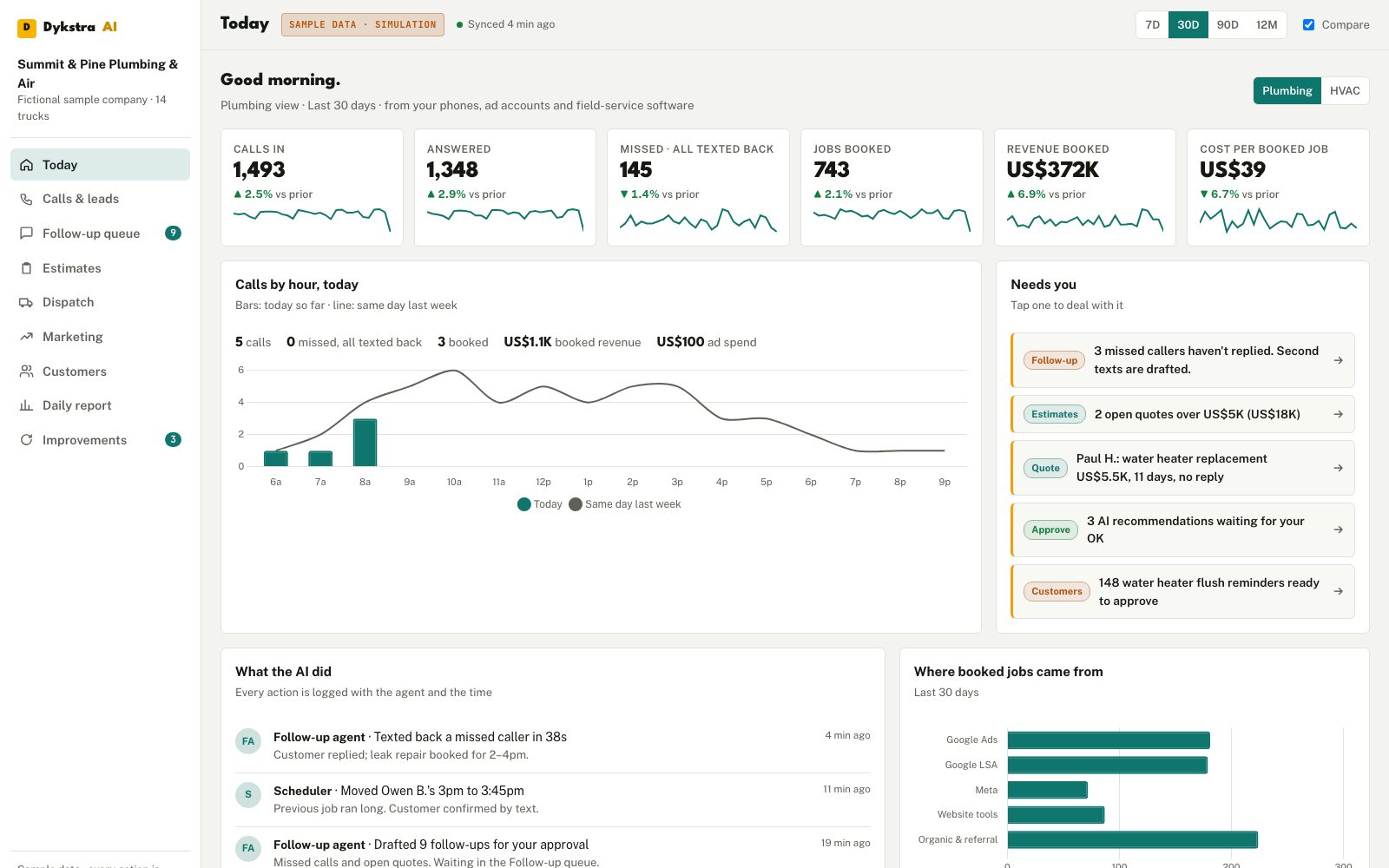
This is what running a plumbing company on AI looks like from the owner's chair. Today's calls, with missed calls already texted back. The follow-up queue and every open estimate. The dispatch board and jobs booked. Cost per booked job by ad source. Maintenance reminders going out, the 7 am report, and an assistant you can ask "what did Google cost us per booked job last month?"

Click around. Approve a recommendation, open the estimate pipeline, ask the assistant a question. It's a fictional company with sample data, and the workflow is the real one.

Interactive demo with fictional sample data. Every action is simulated.

Service Business Operating System demo screenshot with sample dataSample data · click to explore

Optional add-on · custom AI tools

Give your customers a tool they'll actually use.

Most plumbing websites say the same things: years in business, a list of services, a phone number. A tool answers the question the homeowner actually came with, and then offers an exact quote. It's optional, and most clients start with follow-up, ads and tracking. We can build whatever fits your company. A few ideas:

Example concepts
  • Water heater replacement estimatorTank or tankless, household size and fuel type in; size, typical cost range and "get my exact quote" out.
  • Is it time to replace my water heater?Age, symptoms and model sticker photo in; a repair-or-replace verdict and a booking button out.
  • Drain and sewer problem checkerAnswer five questions about the symptom; get the likely cause, urgency and a same-day booking option.
  • Whole-home repipe cost estimatorHome size, age and pipe type in; a cost range and the questions to ask any plumber.

Leads from a tool flow into the same instant follow-up, booking and tracking as every other lead, so a homeowner who sizes a water heater at 9 pm gets a reply in minutes.

How a tool turns visitors into booked jobs
  1. 01Visitfrom search, ads or social
  2. 02Use the toola real answer in minutes
  3. Your choice03Optional capture"email me my results" or "get my exact quote"
  4. 04AI qualifiesjob type, size, timing, area
  5. 05Bookedestimate on your calendar
  6. 06Reportedin your dashboard, by source
Which inputs and offers book the most jobs feeds straight back into the tool

Who you're talking to

Jon Dykstra. I don't teach AI. I run my businesses on it.

Jon Dykstra
  • LLB · Law
  • MBA
  • Founder, Dykstra AI

In 2025 I went through my businesses one job at a time and gave every job AI could do better, faster and cheaper to AI: the content, the ads, the bidding, the social, the email, the lead follow-up and the reporting. Plenty broke. I fixed it with my own money on the line, and kept what worked.

The result is a lead machine running at real scale: 46,800+ leads, 27.3M pageviews and 1,878 AI-launched ad campaigns this year, with every campaign judged every morning. As I put it in my report, "I get roughly 25x done in a quarter of the time." That's my own estimate, and it's the reason I started building this for other owners.

I trained as a lawyer and earned an MBA, so I judge every system like an owner: does it make money, does it save time, and can I trust the numbers? I'm not a plumber, and I won't pretend to know your trade better than you do. What I know is how to capture, follow up and measure leads at real volume, every day, and plumbing is a business where that discipline pays.

A client build for a plumbing company is underway now, and I'm currently accepting a few more clients. You get the system without paying for my expensive year of lessons.

46,800+leads in 2026
485/dayby October
190xorganic Facebook reach
43xgrowth in ad spend managed by AI

Jon's own portfolio. Figures are from businesses Jon Dykstra owns and operates on AI. They are not client results. Data to Oct 11 2026 unless noted. Leads = opted-in email subscribers and home-equity lender leads across businesses Jon owns, Jan 1–Oct 14 2026. Not plumbing client results. 190x compares the week of Oct 5–11 2026 with the average January week; 91% of the final week came from one viral page on a newer site.

You stay in charge

AI does the work. You still run the company.

You set the goals, budgets and limits. AI does the work inside them. Anything that spends money, contacts customers or changes the business can require your approval, and everything is logged.

What stays with you

  • The goals, the budget and the limits
  • Approval of big decisions and new strategies
  • Pricing, hiring and customer relationships
  • Judgment calls on brand, ethics and risk
  • Any job AI can't yet do as well as a person

What AI takes over

  • Research, writing, design and production
  • Launching, judging and tuning ads inside your caps
  • Answering, following up and booking leads
  • Collecting, reconciling and reporting the numbers
  • Spotting patterns and proposing the next test

The guardrails

  • Hard spending caps and bid limits
  • Approval steps on anything sensitive
  • Read-only access to your books
  • A second AI checks work before it goes out
  • A short alert when a person is needed

And it's yours. Everything is built on your own accounts: your ad accounts, your phone numbers, your website, your software, your data. If we ever part ways, it all stays with you.

How it works

From first call to AI-run in about a month.

Everything is built on your own accounts. You own all of it. We run it for you, or train your office to run it.

Week 1

Audit

We map your marketing and operations and rank every job AI could take over by the money and hours it frees up. In most plumbing companies, tracking and missed-call follow-up sit near the top.

Weeks 2–4

Build

The AI systems, tracking and dashboards go in on your own accounts.

Your choice

Teach

Want your team to run it? We train them on every system until they're confident without us.

Or every day

Run

Rather not? We run it for a monthly fee. AI does the work; we watch the numbers and tune the system.

Every week

Improve

AI brings new tests built on your results. You approve them and AI carries them out.

Book my free strategy callOnly a small number of companies are taken on at a time.

Why trust a publisher with a plumbing company?

Because the hard part was never the trade. The hard part is answering every lead fast, following up until it books, tying every dollar to the result it produced and doing that every day without getting tired. I do that across millions of visitors and tens of thousands of leads a year, in businesses I own. Your trade knowledge plus that machine is the combination I'm offering.

Questions

What plumbing owners ask first.

Are your results from plumbing companies?

No, and I'll never pretend they are. The 46,800+ leads and the charts on this page come from businesses I own and run on AI. They're email sign-ups and home-equity lender leads, not service calls. A client build for a plumbing company is underway now. What I'm offering is the same machine, built for your company, on your accounts.

Does this work with ServiceTitan, Jobber or Housecall Pro?

We connect to the field-service software you already use wherever its API and your plan allow it, so calls, bookings and jobs flow into the reporting automatically. If a connection isn't possible, I'll tell you on the call and we'll work around it.

Will AI talk to my customers?

Only where you want it to, in words you approve: missed-call texts, booking confirmations, quote follow-ups and maintenance reminders. Anything unusual, upset or complicated goes to a person.

Will it spend my ad money without asking?

No. You set daily and monthly caps. AI moves budget between campaigns inside those caps and pauses losers by rule. It never raises the total without your approval, and every change is logged.

Do I have to replace my office staff or my agency?

No. Your office keeps the phones and the dispatch board; AI takes the follow-up and the busywork they never get to. If you have an agency, we'll look at what it does on the call. You might keep yours for some channels and let AI handle tracking, follow-up and reporting.

How fast does it start working?

Tracking and missed-call follow-up usually go live in the first weeks of a build, because they pay back fastest. A full build takes about a month.

Who owns everything?

You do. The ad accounts, phone numbers, website, software, data and every rule the system learns are on your accounts. Accounting access is read-only.

What does it cost?

It depends on what AI should take over first and whether we run it or teach your team. You'll get a straight answer and a clear scope on the free call. If you'd like to see how I think first, read the free report. Read the free report first →

Free strategy call

Let's find the leaks in your plumbing company.

  1. Your company. Your service area, your phones, your ads and your software.
  2. Where jobs are leaking. Missed calls, slow quotes, lapsed customers and ads that don't book work.
  3. What AI should take over first. And what it should be worth. A straight answer, no obligation.

Phone or Google Meet, your choice. Times show in your time zone. Only a small number of businesses are taken on at a time. Not ready? Read the free report or send a message.

Loading the calendar…

Open the booking calendar